PDO Thread Lifts in Bethlehem, PA
A Non-Surgical Lift
A thread lift is only as good as the hands performing it. PDO threads require an advanced understanding of facial anatomy, tissue depth, vector placement, and tension. These skills take years of dedicated training to develop and even longer to master.
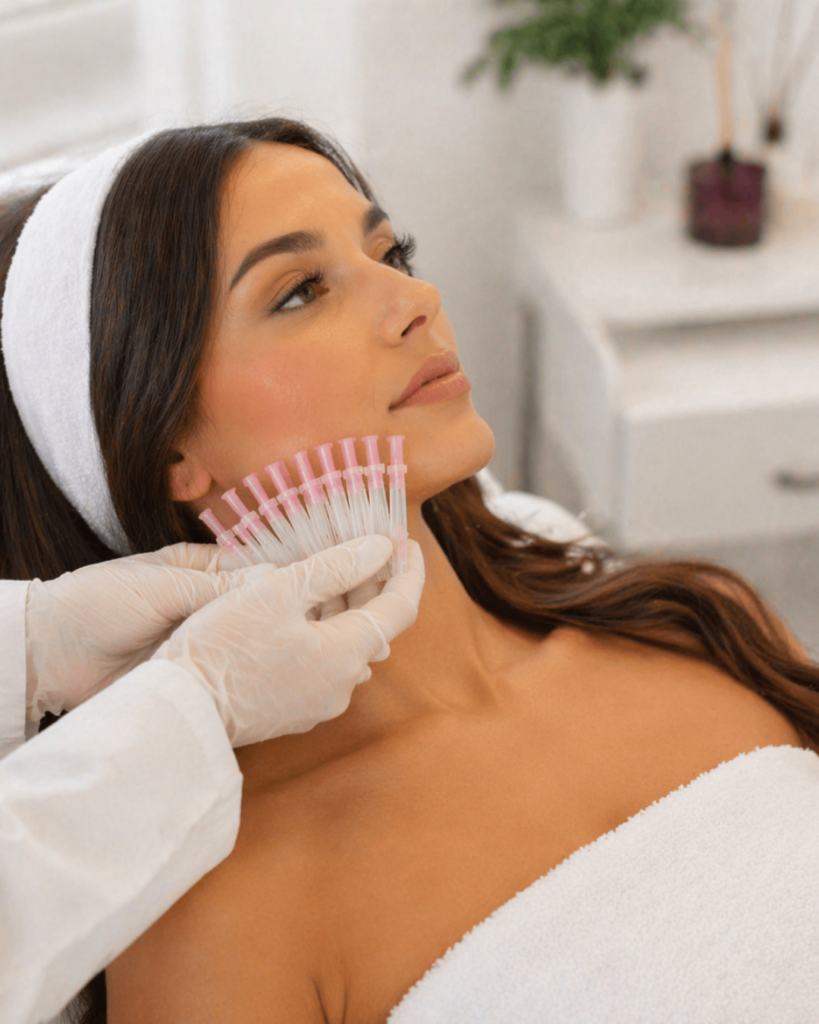
At Posh Medical Spa in Bethlehem, PA, every thread lift is performed by Tricia Vermilya, a nationally certified trainer for Victoria Threads who has studied directly under two of the most respected thread specialists in the country.
Certified Trainer. Not Just Certified.
Tricia Vermilya is a nationally certified trainer for Victoria Threads, meaning she does not just perform thread lifts at the highest level. She trains other medical providers on how to do them. She studied PDO thread techniques directly under Scott Callahan and Francine Young, two of the most respected thread educators in the country. She has been injecting for over twelve years, has been named to the Registry of National Best Aesthetic Injectors in America, and brings the same precision and anatomical understanding to every thread she places.
Common Treatment Areas
We treat every area of the face and neck where PDO threads are clinically appropriate. Below is an overview of the most common treatment zones and what each one addresses.
Jawline and Jowls
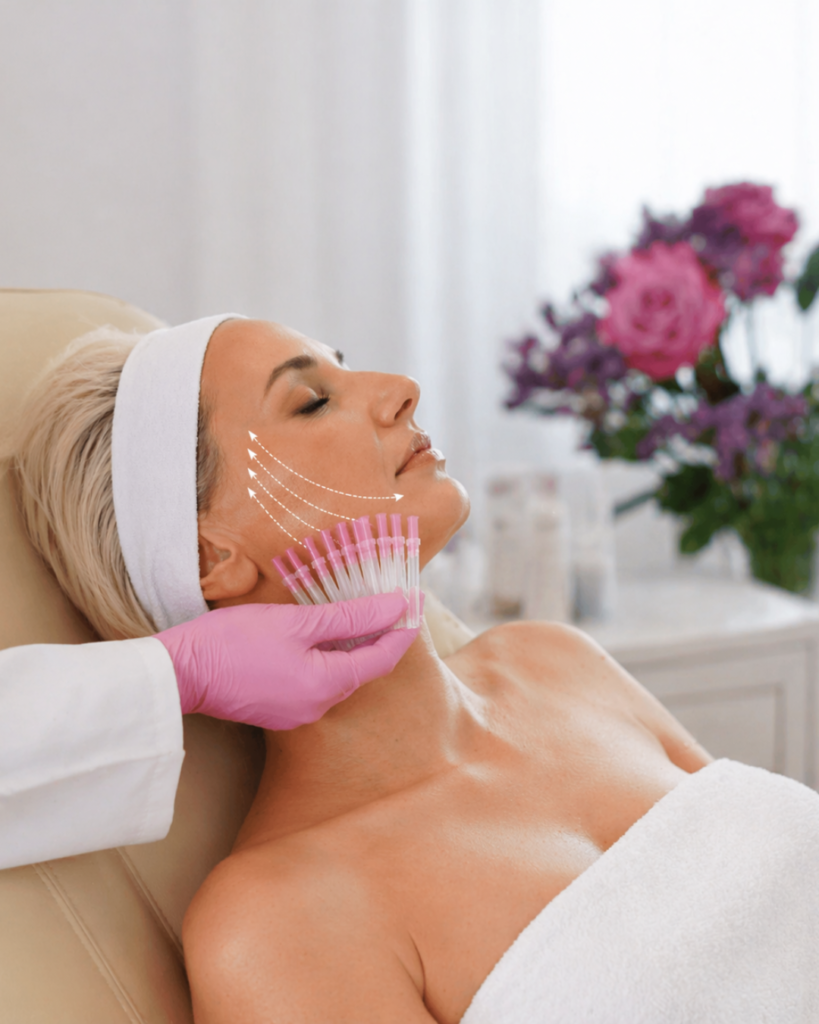
This is the most requested thread lift treatment area, and for good reason. As the skin and underlying tissue along the lower face loses elasticity, jowls form and the jawline loses its definition. Barbed threads placed along the jawline physically reposition the sagging tissue and recreate the clean, defined contour that gravity and time have softened.
Midface and Cheeks
Volume loss and tissue descent in the midface contribute to a flattened, tired appearance and deepen the nasolabial folds below. Threads placed in the midface lift and reposition the tissue, restoring the natural fullness and contour of the cheek while also reducing the severity of the smile lines beneath.
Neck
The neck is one of the most difficult areas to treat nonsurgically, and it is often where aging shows first. Loose skin, horizontal necklace lines, and vertical banding can all be addressed with strategically placed PDO threads. Thread lifts in the neck create a tighter, smoother profile and can dramatically improve the transition from the jawline to the neck.
Brow Lift
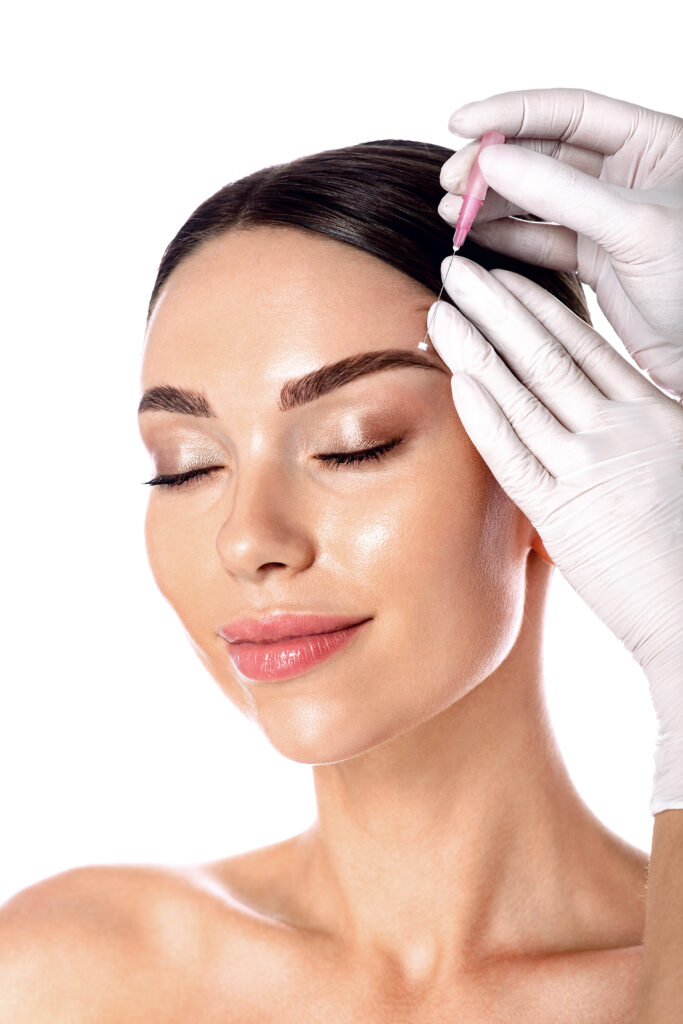
A subtle but powerful application. Barbed threads placed above the brow lift the tissue upward, opening the eye area and creating a more awake, refreshed appearance. This is a precise, conservative correction that addresses the heaviness and hooding that develops as the forehead tissue descends with age. Many patients combine a thread brow lift with neurotoxin treatment of the forehead for a synergistic result.
Nasolabial Folds
Deep smile lines that do not respond fully to filler alone can benefit significantly from the structural support that threads provide. Smooth or screw threads placed in this area create a foundation of collagen that softens the crease and supports the surrounding tissue over time. This approach works especially well in patients who prefer to avoid repeated filler in the nasolabial region.
Forehead and Fine Lines
Smooth threads placed in a mesh pattern across the forehead or around the mouth stimulate collagen production, which tightens the skin, reduces fine lines, and improves overall skin quality.
What Are PDO Threads and How Do They Work?
PDO stands for polydioxanone, a biocompatible, fully absorbable medical-grade suture material that has been used safely in surgical procedures, including cardiothoracic surgery, for over thirty years.
When placed beneath the skin using a thin needle or cannula, PDO threads create an immediate mechanical lift while simultaneously triggering your body’s natural wound healing response.
That healing response is where the real transformation happens. As the threads are absorbed over the following four to six months, your body produces new collagen around each thread, building a stronger, firmer foundation of support beneath the skin. The threads dissolve. The collagen stays. And the results continue to improve for months after the initial treatment.
The effect is a face that looks tighter, more defined, and visibly lifted without the scars, general anesthesia, or extended recovery that come with surgical intervention. Thread lifts are particularly effective in the lower face, jawline, and neck, areas that are notoriously difficult to treat with neurotoxins or filler alone. Most thread lift appointments take thirty to sixty minutes. There is no general anesthesia. Most patients return to normal activities within twenty-four to forty-eight hours.
You will see an immediate lift the day of treatment.
You will see an immediate lift the day of treatment. That lift will settle slightly over the first week as swelling resolves, and then continue to improve over the following three to six months as new collagen builds around the threads. Most patients see their final result at the three month mark, and those results typically last twelve to eighteen months depending on the thread type, the treatment area, and individual collagen response.
We are always available for follow-up questions, and we schedule a check-in after your procedure to make sure everything is progressing as expected.
What to Expect at Your Appointment
Before Appointment
Every thread lift begins with a thorough consultation. We will evaluate your skin quality, the degree of laxity present, your facial structure, and the specific areas you want to address. We will explain which thread types we recommend, how many threads we anticipate using, where they will be placed, and what kind of result you can realistically expect. If we believe another treatment would serve you better than threads, we will tell you that honestly.
During Treatment
The treatment area is marked and local anesthesia is administered to keep you comfortable throughout the procedure. The threads are then inserted beneath the skin using thin needles or cannulas, carefully placed along predetermined vectors to create the desired lift and support. Most thread lift procedures take between thirty and sixty minutes depending on the number of threads and the areas being treated. You are awake the entire time.
After Treatment
You can expect some mild swelling, tenderness, and a sensation of tightness in the treated area for the first few days. Minor bruising at the insertion points is possible and typically resolves within a week. We recommend sleeping on your back for the first week, avoiding extreme facial expressions and wide mouth opening for about two weeks, and holding off on strenuous exercise for five to seven days.
Why Patients Trust Posh for Thread Lifts
Thread lifts are an advanced procedure. The margin between a beautiful result and a visible complication is smaller than with most other aesthetic treatments. Threads placed too superficially can be seen or felt through the skin.
Threads placed with incorrect vectors will pull the tissue in the wrong direction. Threads placed without proper tension will not hold. And threads placed by someone without the training to manage these variables will deliver a result that falls short of what the procedure is capable of producing.
That is exactly why credentials matter here more than with almost any other treatment we offer.
Patients drive from across Easton, Bethlehem, Allentown, and the surrounding Lehigh Valley to have their thread lifts performed at Posh. Many of them researched extensively before choosing a provider, and they chose us because the level of training and specialization here is not something they could find closer to home.
Our Thread Products and Types
We use Victoria Threads and Nova Threads, two of the most trusted and widely respected PDO thread brands on the market. Each brand offers a full range of thread types, and we carry the complete lineup so that we can match the right thread to the right area, the right concern, and the right patient.
The type of thread we select depends on whether the goal is lifting, tightening, collagen stimulation, volume restoration, or some combination of all of them.
Here is an overview of the thread categories we use and what each one does.
BARBED THREADS (LIFTING THREADS)
Barbed threads are the workhorse of any thread lift procedure. They feature tiny hooks or cogs along their length that grip the tissue beneath the skin, creating a mechanical anchor that physically lifts and repositions sagging tissue. Barbed threads provide the most visible, most immediate lift of any thread type and are ideal for the midface, jawline, jowls, and neck. As the threads dissolve, collagen forms around the barbs, maintaining the lift well beyond the life of the suture itself. We use both unidirectional and bidirectional barbed threads depending on the treatment area and the degree of lift required.
SMOOTH THREADS (MONO THREADS)
Smooth threads are single-strand sutures without barbs. They are placed in a mesh or crosshatch pattern beneath the skin to create a scaffold that stimulates collagen production over time. Smooth threads do not provide the dramatic lift that barbed threads do, but they are exceptional for improving skin quality, tightening mild laxity, reducing fine lines, and creating a smoother, firmer texture across the treatment area. They are particularly effective on the forehead, around the eyes, in the perioral region, and on the neck.
SCREW AND TWIST THREADS
Screw threads consist of one or two intertwined threads coiled around the needle. They are designed to add subtle volume and lift to areas that appear hollow or sunken, such as the nasolabial folds, the corners of the mouth, and the lateral cheeks. The coiled structure provides a gentle plumping effect while still triggering collagen production. Twist threads are especially useful when volume restoration and skin quality improvement are both priorities.
BEYOND THREADS AND SOG THREADS
Beyond Threads are an advanced category designed for enhanced grip and longer-lasting structural support. SOG (Soft Orientation Guidance) threads feature a specialized barb pattern that allows for controlled, directional lifting with a softer, more natural tissue response. These threads give us additional precision and flexibility when treating complex areas or when a patient needs structural correction that standard barbed threads alone cannot fully address.
12+ YEARS INJECTING
95+ FIVE-STAR REVIEWS
3 Thread Brands
Cert. TRAINER & EDUCATOR
Top NATIONAL INJECTOR
All Thread Types
Frequently Asked Questions
How long do PDO thread lift results last?
Most patients enjoy visible results for twelve to eighteen months after treatment. Some patients choose to repeat the procedure annually to maintain and build upon their results over time.
Does a thread lift hurt?
Local anesthesia is applied before the procedure, so most patients experience only mild pressure or a tugging sensation during thread placement. The discomfort is very manageable. After the procedure, you may feel some soreness and tightness for the first few days, similar to what you would feel after a deep tissue massage in the face.
Will the threads be visible under my skin?
When placed properly at the correct depth and with appropriate tension, the threads should not be visible or palpable through the skin. This is one of the key reasons why provider training and experience matter so much with this procedure. Threads placed too superficially are more likely to be seen or felt. Our training and technique are specifically focused on avoiding this outcome.
What is the difference between a thread lift and a surgical facelift?
A surgical facelift involves incisions, removal of excess skin, repositioning of deeper tissue, general anesthesia, and a recovery period of several weeks. A thread lift is minimally invasive, performed under local anesthesia, requires minimal downtime, and achieves its results through tissue repositioning and collagen stimulation rather than tissue removal.
Am I a good candidate for a thread lift?
Thread lifts are best suited for patients with mild to moderate skin laxity who want visible improvement without surgery. Ideal candidates are generally between the ages of thirty-five and sixty-five, though this varies based on individual skin quality and goals.
How many threads will I need?
The number of threads depends on the treatment area, the degree of laxity, and the result you want to achieve. A jawline lift might require eight to twelve threads per side. A brow lift might require four to six. A full face treatment combining multiple areas will use more. We will give you a clear recommendation and transparent pricing during your consultation so there are no surprises.
Ready to See What a Real Thread Lift Can Do?
- 4331 Easton Ave, Bethlehem, PA 18020
- (484) 788-3491